Before the stage, there is the counter
I want to tell you about the night before Milan. Not the routine. Not the score. The night before.
I was in a hotel room in a city I had only ever seen in pictures. Two competition machines I had bought time on. A sensory panel of three people who had flown out of their own pockets to help me. A coffee from Maguta Estate that I had cupped a thousand times. I could not sleep. I sat on the floor in the dark and asked myself the only honest question there is to ask the night before any big stage.
Did I do the work?
That is the question. Not am I good enough?, which is a question you cannot answer in the dark. Not will I win?, which depends on five judges and the calibration of their morning. The only question that is answerable, the night before, is whether you did the work. Sitting on the carpet at 2 a.m. in Milan, I knew that I had.
That is the first thing I want to say to anyone who wants to be a champion at anything. The stage is the easy part. The stage is ten minutes. The work is the four years before it.
The first cup is rarely beautiful
I did not plan to live in coffee. I wanted to be an architect. I wanted to design buildings that would outlast me. When I left high school, my family needed money more than I needed a degree. I walked into Artcaffé in Nairobi and said I would do anything. They gave me a tray and an apron and put me behind the counter.
For the first six months I was, by any reasonable measure, bad at coffee. I burned milk. I ran shots gushing. I once served a man a flat white that he politely returned with the words “this is, technically, a soup”. I still think about him. He was kind.
I tell you this because nobody who watches a champion routine ever sees the soup. They see the polished hands, the calibrated voice, the steamed milk poured in a perfect rose. They do not see the six months of soup. So they think the difference between them and the champion is talent. The difference is almost entirely a thousand bad cups that the champion was willing to make in public.
Make the bad cups. Make them in front of people. Apologise, re-pull, learn. The path to a great cup runs directly through a thousand bad ones, and there is no detour. None.
The work is boring on purpose
Here is what training for a world barista championship actually looks like. I am going to be precise so you can taste it.
You wake up at 5 a.m. You walk to the bar. You pull twelve identical shots and weigh every one of them. You discard anything more than 0.2 grams off your target. You taste every one. You write down what you tasted. Then you change one variable. The grind. Or the dose. Or the temperature. Or the basket. You do it again. Twelve more shots. Twelve more tastings. Twelve more notes.
You do this until your tongue is exhausted and your hands are shaking and you have used a kilo of green and a litre of milk and you have nothing to show for it except a notebook with twelve tiny, almost-identical descriptions of espresso. Then you wash the bar. You go home. You sleep. The next day you do it again.
Anyone who tells you that championship coffee is glamorous has never trained for one. It is, almost entirely, the work of calibration. The patient narrowing of variables until you can produce the same cup on the worst morning of your year. The romance happens later, on the stage, when those four years of calibration buy you one perfectly identical pour in front of the people who can tell.
The romance you see on stage is paid for, in full, by the boring work nobody saw.
The doubt is the loudest in the middle
People ask me when I almost quit. The honest answer is: many times, but loudest in the middle.
The beginning is exciting. You are bad and you are getting better and every small improvement feels like a flag planted. The end is exciting too. The stage is in sight, the months counting down. But the middle. The middle is a long flat road in the dark, where you are no longer obviously improving, and the stage is too far away to imagine, and the people you love are tired of hearing about coffee, and you start to ask yourself whether any of this is worth the years it is taking.
In the middle of my training for Milan, I had a stretch of three months where every shot I pulled tasted, to my palate, like the same shot. I could not find another note in the cup. I thought I had hit my ceiling. I thought maybe my palate was simply a ceiling, and the people who could taste further were people built differently than me.
The thing that pulled me through was a sentence from one of my coaches. He said: “the plateau is the moment your palate is rebuilding underneath you. Stay on the plateau. Trust the plateau.”
He was right. Six weeks later I could taste differences in the same lot that I had not tasted in months. My palate had been quietly rewiring itself in the dark, the way they always do when you keep showing up.
The lesson is small and very large at the same time. The plateau is part of the work. Do not flee it. Do not change your craft because of it. Trust it, and keep showing up.
A champion is built by other people
The story the cameras tell, on the stage, is the story of one person with a tamper and a smile. The story is a lie. Or, to be more generous, the story is one tenth of the truth, with the other nine tenths cropped out of the frame.
I did not get to Milan alone. I got there carried by:
- The farmers at Maguta Estate, who let me cup their harvest at lot level and taught me what altitude does to acidity at first hand.
- The roasters in Nairobi who burned through their own beans on test profiles so I could find a development I trusted.
- The three judges who flew out of pocket to sit in front of me in that Milan hotel room, at midnight, and tell me the truth about my last practice routine.
- The team at Sanremo who calibrated the competition machine to exactly the spec I needed and stayed up with me on the night before the round.
- My family, who carried the cost of my apprenticeship years before there was any sign at all that this would lead anywhere.
- The strangers in the audience who, when I walked on stage as the first African finalist in WBC history, stood up before I even started, because what was about to happen meant something to them too.
If you want to be a champion, you have to do the opposite of what champions are told to do in the movies. You have to ask for help. You have to find people who are better than you in specific ways and ask them to sit with you and tell you the truth. You have to be willing to be the worst person in the room. You have to be willing to be coached.
The lone genius is a story we tell because it is easier than the truth. The truth is that every great cup is the cup of dozens of hands.
Why representation matters more than trophies
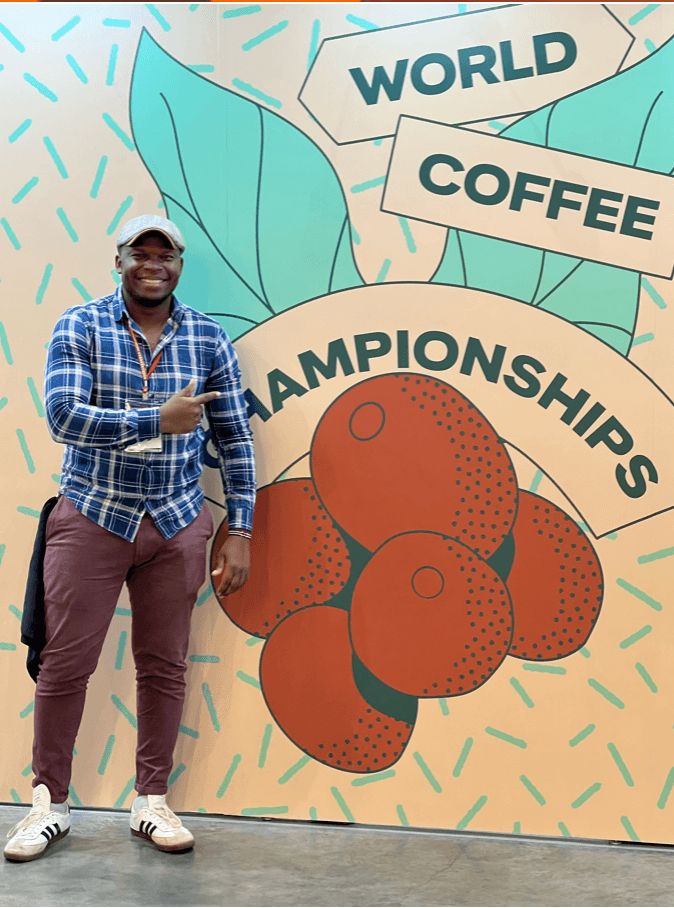
When I walked onto the stage in Milan in 2021, I became the first African to ever make a World Barista Championship final. The competition had been running for twenty-one years.
Take that in. Twenty-one years. A continent that grows some of the most important specialty coffee on earth. No finalist.
I want to be careful when I talk about this, because the temptation is to make it sound like a glorious individual achievement, and it was not. It was a structural correction. The talent had always been on this continent. What had not been on this continent was the training infrastructure, the funding, the calibrated sensory panels, the visa support, the coaches with international competition experience. The gap between African baristas and a WBC final was never a gap of talent. It was a gap of access.
When I came fifth in Milan, my phone did not stop ringing for three weeks. Most of the calls were from young baristas across the continent. Rwanda. Tanzania. Uganda. Ethiopia. Cameroon. They said some version of the same sentence: I didn't know we were allowed to be on that stage.
That sentence is why I do this. Not the trophy. The sentence.
The most important thing any champion can do is not to win again. It is to walk back down the stairs from the stage and use the ladder you climbed to make the stage easier to reach for the next person. If the champion who comes after you cannot see the rope you climbed, you wasted the climb.
The point of being first is not to be remembered as first. The point is to make “first” the wrong word, as fast as possible.
What I would tell the barista I was at 19
If I could sit across from the 19-year-old version of me at Artcaffé, the one apologising for the soup-flat-white, I would tell him five things.
One. The work is the point. Not the trophy. Not the stage. The work. Fall in love with the calibration, with the twelve shots in a row, with the quiet morning bar before anyone walks in. The trophy is a side effect of the work. If you make the trophy the point, you will quit when the work gets boring. And it will get boring.
Two. Ask for help, immediately and constantly. The fastest path forward is not what you can figure out alone in your head. It is what you can be told by someone who has been where you are going. Find those people. Pay them in beer if you have to. Buy them coffee. Listen.
Three. The plateau is part of the path. It is not a sign that you have arrived at your ceiling. It is the sign that your palate, your hands, your craft are rebuilding themselves underneath you. Trust the plateau.
Four. The story you tell about yourself matters. You are not an apprentice barista from a Nairobi cafe chain who got lucky. You are an apprentice barista from a Nairobi cafe chain who is putting in the work. The luck comes later. The work is now.
Five. When you make it, and you will, the job is to send the ladder back down. There is no version of being a champion that is just about you. If your win does not open a door for someone else, your win was small.
The cup you serve tomorrow
I want to end on the smallest possible note, because that is where this work actually lives.
There is a cup of coffee you are going to serve tomorrow. It might be to a paying customer at your bar. It might be to your flatmate. It might be to yourself, alone in your kitchen, at 6 a.m. before the day starts.
That cup. That is where you are a champion or not.
Pull it like the judges are watching. Steam the milk like it matters. Taste it before you serve it. If it is not right, pull it again. Apologise to nobody for the time it takes. Care, in public, about the small invisible thing that everyone else is in a hurry to skip past.
That is the work. There is no other work. The stage is just the place where the people who did this small thing, every day, in private, get to do it once with a camera on them.
So make the cup. Make it tomorrow. Make it the next day. Make it for four years.
And then I will see you at the championships.
Martin Shabaya
Nairobi · Brave since 2022